
How much does it cost to advertise to motorsport customers?
The answer depends on where you advertise, which audience you want to reach and what you expect your campaign to achieve.
A racing brand might invest in social media advertising, specialist motorsport websites, racing team sponsorships, trade shows or a combination of several channels. Each has a different cost structure and serves a different purpose.
The challenge is not simply finding the cheapest advertising. It is understanding how much you are paying, who you are reaching and whether that exposure supports your business objectives.
This guide explains the main motorsport advertising options, how CPM pricing works and how to compare campaigns more effectively.
1. How much does motorsport advertising cost?
There is no single standard price for motorsport advertising. Costs depend on the channel, audience, placement, campaign duration, geographic coverage and level of demand.
Here are the main options to consider.
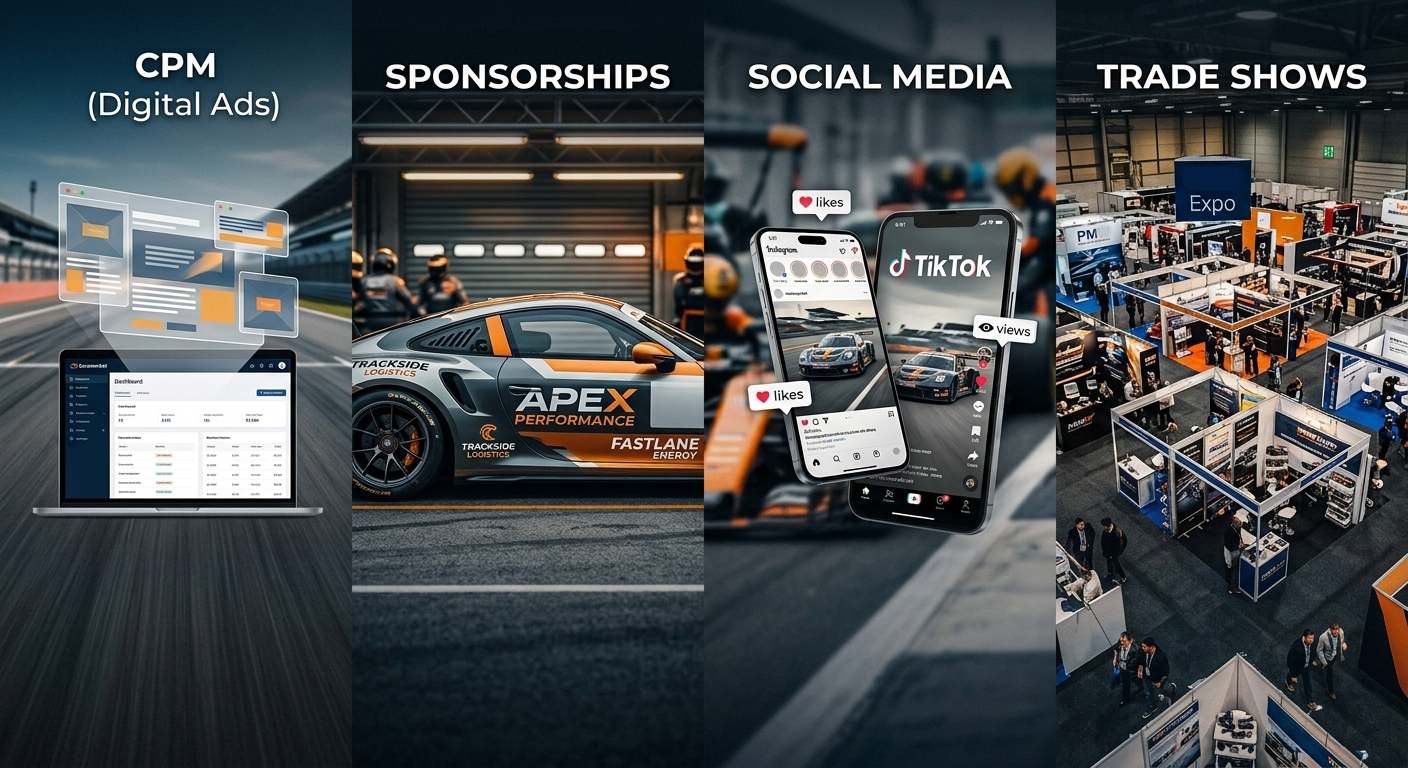
| Advertising channel | Typical cost structure | Best suited to |
|---|---|---|
| Digital display advertising | CPM or other media-buying models | Brand awareness and audience reach |
| Specialist motorsport websites | CPM, fixed placements or negotiated packages | Reaching relevant motorsport audiences |
| Social media advertising | Auction-based pricing, often measured by CPM, CPC or conversions | Awareness, product promotion and lead generation |
| Search advertising | Commonly cost per click | Capturing existing product demand |
| Racing team and driver sponsorships | Negotiated sponsorship packages | Credibility, relationships and racing visibility |
| Trade shows and exhibitions | Stand fees plus travel, staffing and other expenses | Direct contact, demonstrations and B2B relationships |
| Influencer and content partnerships | Fixed fees, negotiated packages or performance-based arrangements | Demonstrations, storytelling and audience engagement |
| Email marketing | Platform, production and list-management costs | Communicating with an existing, permission-based audience |
These models are not directly interchangeable. A sponsorship package may include hospitality and content rights, while a CPM campaign purchases a defined quantity of advertising impressions.
To compare options fairly, consider both the total cost and the outcome each channel is designed to deliver.
2. What is CPM advertising?
CPM stands for cost per mille, meaning the cost per 1,000 advertising impressions.
It is commonly used for digital display advertising and other campaigns designed to deliver exposure.
The calculation is straightforward:
Campaign cost = impressions ÷ 1,000 × CPM
For example, if your CPM is €8:
-
10,000 impressions cost €80.
-
50,000 impressions cost €400.
-
100,000 impressions cost €800.
-
250,000 impressions cost €2,000.
These are illustrative calculations, not quoted market rates.
The reverse calculation is also useful:
CPM = campaign cost ÷ impressions × 1,000
If you spend €500 and receive 100,000 impressions, your effective CPM is €5.
This makes it possible to compare the media cost of campaigns using the same metric, provided that you understand what each campaign includes and how its impressions are measured.
3. Why the lowest CPM is not always the best value
A low CPM can look attractive, but it tells you how much you pay for impressions, not whether those impressions are commercially relevant.
Consider two hypothetical campaigns, each costing €500.
Campaign A
-
Impressions: 500,000
-
Assumed relevant audience: 0.1%
-
Estimated relevant impressions: 500
Campaign B
-
Impressions: 100,000
-
Assumed relevant audience: 10%
-
Estimated relevant impressions: 10,000
Campaign A generates five times more impressions. However, under these illustrative assumptions, Campaign B delivers 20 times as many impressions to the relevant audience for the same budget.
These figures are examples, not measured audience-quality estimates for any advertising platform.
The lesson is that total impressions and relevant impressions are different measures. Even a relevant impression does not guarantee a click or purchase, but audience relevance is an important consideration when choosing where to advertise.
For a company selling racing tyres, suspension components or safety equipment, a smaller specialist audience may be more valuable than a much larger general audience.
4. Motorsport website advertising
Advertising on specialist motorsport websites gives businesses access to audiences already engaging with racing-related content, vehicles, parts and equipment.
The available formats and pricing models vary by publisher. Some offer fixed placements, others use CPM pricing, and some negotiate packages based on campaign scope.
When evaluating a specialist website, ask:
-
How many people visit the site, and over what reporting period?
-
Which countries do they come from?
-
What types of products and motorsport categories do they engage with?
-
Where will the advertisement appear?
-
Is the campaign priced by impressions, time or another measure?
-
Can performance be tracked through reporting?
-
Can you select markets or placements relevant to your business?
The key is to assess whether the environment aligns with your target customer, rather than choosing a publisher solely because it reports a large audience.
Advertising across multiple specialist marketplaces
Racemarket Apex is designed for businesses that want to advertise across a network of specialist motorsport marketplaces through one platform.
The Racemarket network comprises 20 European marketplaces, with coverage across 24 European countries.
Depending on the campaign format, advertisers can use banner placements for brand visibility, Spotlight Ads for exposure within relevant browsing environments, or ShopPack listings to present their business and link to their website.
Campaigns use CPM-based pricing. Advertisers can choose suitable markets, set their budgets and monitor campaign performance through the platform. The applicable bid and campaign settings are displayed during campaign setup.
This gives businesses a way to test specialist motorsport advertising without negotiating a separate media package for every marketplace.
5. Social media advertising costs
Social media platforms offer broad reach, visual formats and targeting options. They can be particularly useful for product launches, demonstrations, brand awareness and remarketing.
Depending on the platform and campaign objective, costs may be assessed through CPM, CPC or conversion-based metrics.
However, a low social media CPM does not automatically mean that a campaign is effective for a specialist motorsport business.
A person interested in racing videos may not be shopping for racing parts. Interest targeting can help narrow the audience, but it does not guarantee purchasing intent.
When evaluating social media campaigns, consider:
-
Cost per relevant website visit.
-
Engagement with the advertised product.
-
Qualified enquiries or leads.
-
Conversion rate.
-
Cost per acquisition, where measurable.
-
Revenue attributable to the campaign.
Social media and specialist marketplace advertising serve different purposes. The former can introduce products to people based on interests and targeting signals; the latter places advertising within a dedicated motorsport marketplace environment. Many businesses can benefit from using both.
6. Racing team and driver sponsorship costs
Sponsorship can provide valuable visibility and credibility, particularly when the sponsored team or driver is closely associated with the product.
Costs vary enormously depending on the racing discipline, competition level, team, deliverables and duration of the agreement. There is no reliable universal price for a motorsport sponsorship.
A package may include car branding, driver apparel, social media posts, website placement, hospitality, event appearances or content rights.
Before committing, establish exactly what is included and how success will be evaluated.
Questions to consider include:
-
Does the audience overlap with your target customers?
-
What visibility is guaranteed?
-
How many events or appearances are included?
-
Can you use the resulting content in your own marketing?
-
Are there opportunities for product demonstrations or customer introductions?
-
How will you assess the commercial value of the partnership?
Sponsorship is not simply an alternative to digital advertising. It can build credibility and relationships, while digital campaigns can maintain visibility and direct interested customers to your products.
For many businesses, the two approaches are complementary.
7. Trade shows and exhibitions
Trade shows can be valuable for companies selling technical products, developing distributor relationships or meeting professional buyers.
However, the true cost extends beyond the stand fee.
A realistic budget may need to include:
-
Stand rental and construction.
-
Transport and logistics.
-
Travel and accommodation.
-
Staff time.
-
Samples and promotional material.
-
Installation and dismantling.
-
Follow-up activities after the event.
A three-day exhibition can generate important business opportunities, but its commercial value depends on the quality of the contacts and what happens afterwards.
Digital advertising offers a different model: exposure can continue beyond the event and can be adjusted as your business priorities change.
Rather than treating one channel as a replacement for the other, consider how they can support one another. An exhibition may generate contacts and product interest, while ongoing advertising helps keep your company visible between events.
8. How to calculate a realistic advertising budget
Start with the commercial objective rather than an arbitrary number of impressions.
If your goal is brand awareness, you may want to estimate how much exposure a budget can deliver.
If your goal is website traffic, estimate the visits required and the cost of generating them.
If your goal is qualified enquiries, work backwards from the number of leads you need and your expected conversion rate.
For example, suppose you want 20 qualified enquiries and your website converts 2% of relevant visits into enquiries.
You would need approximately 1,000 relevant visits to reach that target, assuming the conversion rate holds.
The next step is estimating the cost of acquiring those visits. That will depend on the channel, audience, creative, landing page and campaign performance.
For CPM advertising, remember that impressions are not the same as visits. You will need an estimate of click-through rate to model traffic, and you should treat that estimate as an assumption until you have actual results.
A useful budget plan therefore separates:
-
Media spend.
-
Creative production and campaign setup.
-
Website or landing-page costs.
-
Measurement and reporting.
-
The commercial outcome you want to achieve.
Start with a manageable test budget, measure performance and increase investment when the results justify it.
9. How to evaluate advertising performance
No single metric tells the whole story.
For CPM campaigns, track the impressions delivered, effective CPM, clicks where applicable and performance by market or placement.
For traffic campaigns, evaluate relevant visits, engagement and the actions visitors take after arriving.
For lead-generation and sales campaigns, focus on qualified enquiries, cost per lead, conversion rate, sales and customer acquisition cost where attribution is reliable.
It is also important to distinguish between advertising delivery and business results. A campaign can deliver every impression purchased without generating a sale. That does not necessarily mean the campaign was delivered incorrectly; it may indicate that the audience, creative, offer, landing page or objective needs improvement.
Where possible, use consistent tracking and compare campaigns over similar periods. For high-value products, allow for longer buying cycles and interactions across multiple channels.
10. A practical approach for motorsport businesses
For many motorsport businesses, the most sensible strategy is a combination of channels rather than reliance on a single source of exposure.
Use SEO to build long-term visibility around your products and applications.
Use paid search to capture customers already looking for what you sell.
Use social media to demonstrate products, share technical content and build brand awareness.
Consider sponsorships and trade shows when relationships, credibility and direct contact are important.
Use specialist motorsport advertising when you want to reach an audience within a dedicated motorsport marketplace environment.
Start with a clear objective, test your assumptions and evaluate the results. Increase investment in the channels that contribute to your business goals.
Advertise to motorsport customers with Racemarket Apex
Racemarket Apex enables businesses to run advertising campaigns across the Racemarket network of European motorsport marketplaces through one platform.
The network covers 20 marketplaces across 24 European countries. Businesses can select suitable markets and advertising formats, control their budgets and monitor campaign performance.
Campaigns use CPM-based pricing, with the applicable bid and campaign settings shown during setup. There are no long-term advertising contracts, and campaigns can be paused when required.
You can start with €30 in advertising credit without making an initial payment.
Register for Racemarket Apex to explore the available campaign options.
The objective is not to buy the largest possible number of impressions. It is to understand what you are paying for, reach an audience relevant to your business and evaluate whether that exposure supports your commercial goals.
 We have installed cookies on your computer that are strictly necessary to display the site and do not collect personal information. The site also uses cookies to provide a better user experience, which will only be installed if you agree with this.